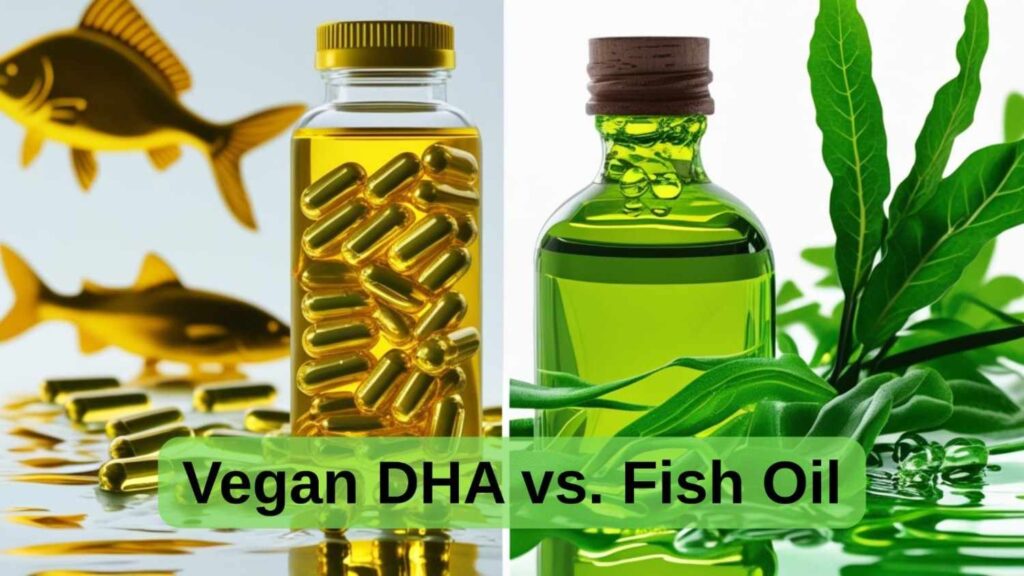
You open Amazon. Two vegan DHA supplements side by side.
One is ₹650. One is ₹1,400.
Same “algal oil” on both labels. Same “vegan DHA” claim. You read both descriptions three times and still cannot figure out what justifies the price difference.
Most Indian buyers either pick the cheaper one and hope for the best, or pay more assuming expensive means better. Both approaches leave money on the table — or worse, leave you with a supplement that was never going to work.
The vegan DHA supplement price in India is real — but what drives it is not always what you think. This guide breaks it down honestly so you stop guessing and start choosing with a reason.
This guide covers what actually drives the price difference — and whether paying more makes a measurable difference for your health.
For a complete reviewed comparison of top vegan DHA options already checked against quality criteria — Best Vegan DHA Supplements in India — Top 3 Picks
What Actually Makes a Vegan DHA Supplement More Expensive
Price differences in vegan DHA supplements almost always come down to three things. Not packaging. Not marketing. Three specific production choices that cost money to get right.
Algae Source and Extraction Quality
Not all algae are the same.
Budget supplements often use lower grade algae strains that produce less concentrated DHA per batch. Premium brands use specific microalgae strains — often Schizochytrium or Thraustochytrid — that produce significantly higher DHA concentrations naturally.
The extraction process matters too. Molecular distillation — used by better brands — removes contaminants and concentrates DHA more effectively than standard cold pressing. It costs more. But it produces a cleaner, more potent oil.
For Indian conditions specifically, this matters more than most people realise. Algal oil is sensitive to heat and humidity. Supplements that travel through India’s supply chain without proper stability testing can degrade before they reach you. Premium brands invest in stability testing. Budget brands often do not.

Third Party Testing
This is where the biggest invisible cost lives.
Third party testing — sending every batch to an independent lab to verify DHA content, check for contaminants, and confirm label accuracy — costs brands significant money per batch. That cost gets passed to the buyer.
When a supplement is priced very low, the first thing brands cut is third party testing. The label still says 300mg DHA. There is no independent verification that 300mg is what you are actually getting.
For a nutrient like DHA where consistency and dosage matter for results, this is not a small thing to skip.
When a supplement is priced very low, the first thing brands cut is third party testing.
Capsule Shell and Delivery System
A standard gelatin capsule costs a fraction of what an HPMC vegetarian capsule costs. Enteric coated or delayed release capsules — designed to open in the intestine rather than the stomach — cost even more.
Premium vegan DHA supplements use proper vegetarian shells and sometimes enteric coating. Budget supplements often use gelatin or basic shells that dissolve quickly, sometimes before the oil reaches optimal absorption zones.
For Indian buyers who have complained about nausea or stomach upset from vegan omega 3 — the capsule quality is often the actual reason.
What Cheap Vegan DHA Supplements Usually Cut
Understanding what you are actually giving up at lower price points matters before deciding whether the saving is worth it.
DHA content accuracy
Without third party testing, the DHA amount on the label is unverified. A supplement claiming 300mg DHA may be delivering 180mg consistently. You would never know.
Algae oil quality and freshness
Cheaper algae oil sourcing often means less stable oil. Oxidised omega 3 delivers less, tastes worse, and is the most common reason people say vegan DHA gave them stomach issues. The supplement was not the problem. The oil quality was.
Capsule integrity in Indian conditions
Budget capsule shells react to Indian heat and humidity faster. A supplement that worked fine in controlled storage conditions may have already partially degraded by the time it reaches your home in summer.
If you have already tried a vegan omega 3 supplement and felt nothing — ingredient quality is one of the most common reasons. This guide covers how to identify a high-quality algal oil before buying — How to Identify High Quality Algal Oil
Is the Vegan DHA Supplement Price in India Actually Worth It — Honest Answer
Here is the part most supplement content avoids saying directly.
Not always.
Some premium priced supplements are worth every extra rupee — because the DHA content is verified, the oil is stable, and the capsule is designed for proper absorption. Some are overpriced because of packaging, influencer marketing, and brand positioning that has nothing to do with what is inside.
Budget algal oil brands often deliver solid quality without the markup — when you skip fancy packaging and celebrity deals, you get clean sourcing at honest prices.
The price itself tells you nothing. What tells you something is what the brand does to justify the price.
The price itself tells you nothing. What tells you something is what the brand does to justify the price.
| Price Range | What You Usually Get | What to Check |
| Under ₹800 | Basic algal oil, limited testing | DHA mg clearly stated, algal oil source confirmed |
| ₹800 to ₹1500 | Better sourcing, some testing | Third party COA available, vegetarian capsule confirmed |
| Above ₹1500 | Premium extraction, full testing | Stability testing mentioned, enteric coating if relevant |

The table is a guide, not a rule. A ₹650 supplement with clear DHA labelling and algal oil sourcing can outperform a ₹1,400 supplement that spends its budget on packaging.
At VeganVitaa, I have personally gone through this confusion myself — spending more on a supplement that turned out to be mostly packaging, and finding a budget option that delivered better results. Price taught me nothing. Label transparency taught me everything.
For the research on what omega 3 supplement quality actually means for absorption — NIH Omega 3 Quality and Absorption Overview
What to Look for at Every Price Point
Budget — Under ₹800
Carbamide Forte Vegan DHA
500mg DHA per capsule from algal oil. FSSAI certified, clearly labelled, widely available. One of the most honest budget options in India — the DHA number is stated clearly and the algal oil source is confirmed. Not the fanciest supplement on Amazon. Does what it says.
Check Carbamide Forte price on Amazon
Mid-Range — ₹800 to ₹1500
Zeroharm Vegan DHA
400mg DHA per capsule from marine algae oil. FSSAI certified for purity. Vegetarian capsule. One of the few Indian brands that clearly states DHA content upfront at a mid-range price. Reliable for daily long-term use.
Check Zeroharm price on Amazon
Premium — Above ₹1500
Unived Ovegha Vegan Omega 3
500mg DHA per serving from algal oil. Third party tested, clean sourcing, no fillers. One of the cleanest formulations available in India at this price point. Worth the premium if you want verified DHA content and stability assurance.
Check Unived Ovegha price on Amazon
For how these three compare on DHA content, sourcing, and who each one suits best — Best Vegan DHA Supplements in India — Top 3 Picks
Disclaimer: This post contains affiliate links. If you buy through these links, I may earn a small commission at no extra cost to you. It helps me keep sharing useful content with you.
Conclusion
Vegan DHA supplement price in India does not always reflect quality — but it is not random either.
The price difference between a ₹650 and ₹1,400 supplement usually comes down to algae extraction quality, third party testing, and capsule integrity. These three things directly affect whether the DHA you are paying for actually reaches your cells in the amount stated on the label.
You do not need the most expensive one. But you do need to know what the cheaper price gave up to get there.
Check the DHA amount. Confirm algal oil as the source. Look for any mention of third-party testing or COA. Those three checks will tell you more than the price ever will.
Where to Start
If you are still deciding which supplement to commit to — start here:
Budget: Carbamide Forte. Mid-range: Zeroharm. Premium: Unived Ovegha.
All three are honest options at their price point. Pick the one that fits your budget and passes the three checks above.
Check the DHA amount. Confirm algal oil as the source. Look for any mention of third-party testing or COA.
For understanding exactly how to read a vegan DHA label before buying — How to Read Omega 3 Label
About the Author
Kamal Mishra is a health & nutrition writer and vegan wellness advocate. He is the founder of VeganVitaa – India’s trusted vegan DHA resource for plant-based families.
For more in-depth information, explore our related guides below to better understand vegan DHA, algal oil, and choosing the right supplement. Blog
Disclaimer: This article is for educational purposes only. Always consult your paediatrician before starting new supplements.
Disclaimer: This post contains affiliate links. If you buy through these links, I may earn a small commission at no extra cost to you. It helps me keep sharing useful content with you.