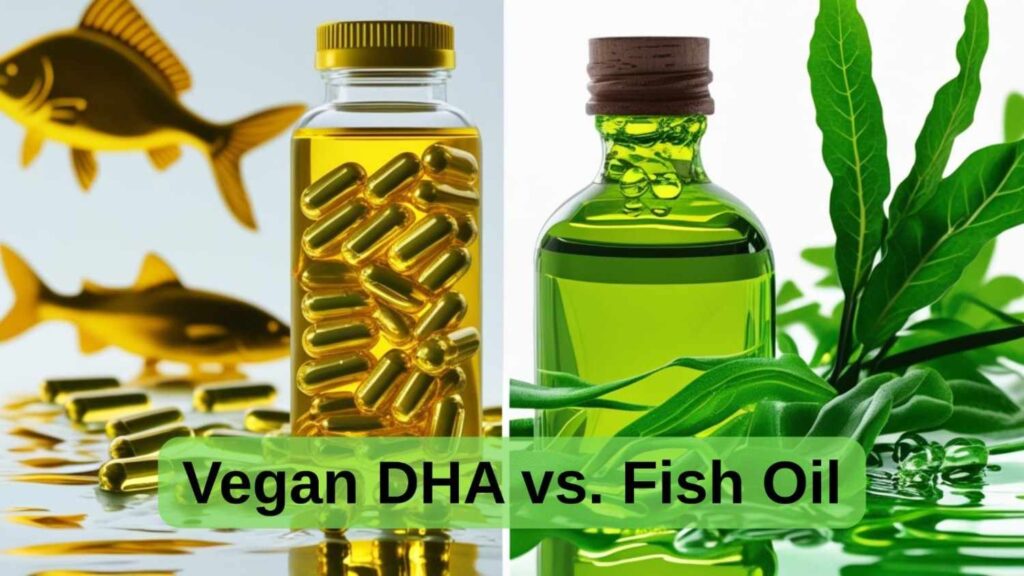
When you grab a DHA supplement, the front of the bottle looks pretty straightforward. You’ll see big numbers staring back at you. The design’s clean. And the promises? They’re so bold, you almost feel like you’re already making a smart choice.
But many buyers miss one small detail that changes everything.
You might have already bought a supplement thinking it was strong, only to realize later that the actual dose per capsule was much lower.
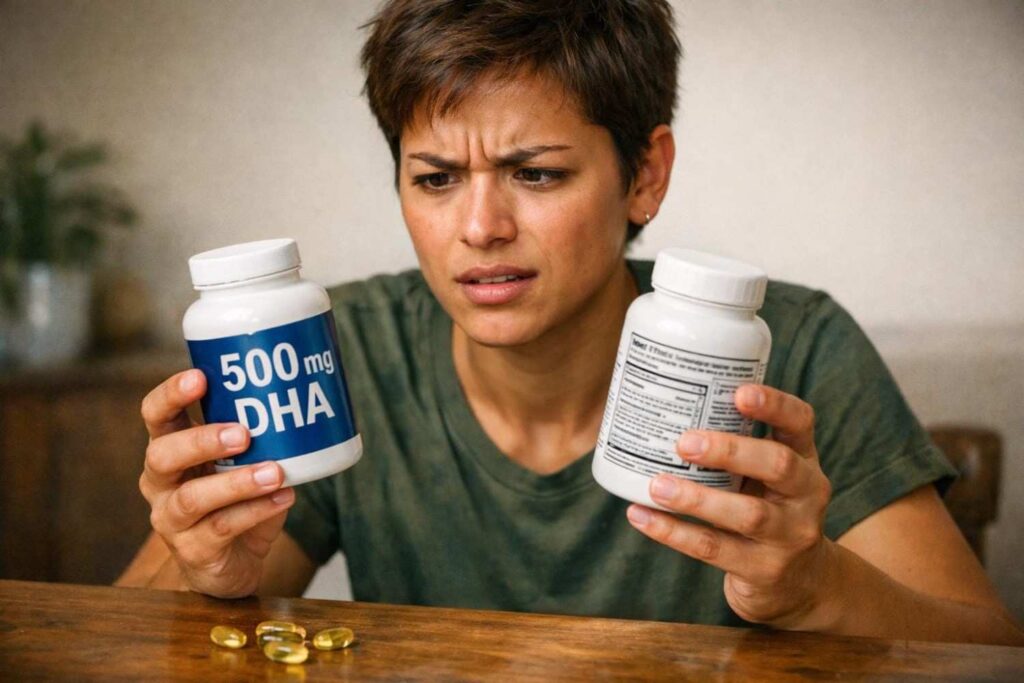
A label may show 500 mg DHA, and that number looks powerful. Yet the real story is often hidden in the serving size. Sometimes that 500 mg is not in one capsule. It may be for two capsules, or even more. That means the actual DHA in one capsule is much lower than you thought.
This is where many people get fooled without even realizing it. They think they are paying for a strong supplement, but the dose they take each day is not what they expected.
That is why understanding dha per capsule vs per serving matters so much.
DHA plays an important role in brain and eye health, as explained by organizations like the National Institutes of Health.
I have seen this confusion many times. Most people do not make a bad choice on purpose – they simply trust the front of the bottle and miss the small print on the back.
That one small detail can change the entire value of a DHA supplement.
Here’s the lowdown on how to read those labels, no fancy science talk needed. It’s about saving your cash, plain and simple. You’ll be able to pick the right DHA stuff without a second thought.
If you’re still confused about which option is actually better, you can also read our detailed guide on best vegan DHA supplements in India to compare top choices clearly.
The Biggest Mistake Buyers Make
Most people make one simple mistake. They just stare at the number splashed across the front of the bottle.
If it says “500 mg DHA,” they assume one capsule gives 500 mg. It feels clear, so they don’t check further. But the real details are on the back.
For example:
- Serving size: 2 capsules
- DHA per serving: 500 mg
This means one capsule gives only 250 mg DHA.
So, if you take just one capsule, you’re getting half of what you expected.
Let’s keep this simple.
This misunderstanding can affect your daily intake.
It also impacts cost. A product may seem affordable at first, but if you need multiple capsules each day, it runs out faster. Over time, you end up spending more.
Most labels are not wrong, but they are easy to misread.
That’s why checking the serving size is just as important as checking the DHA amount.
DHA Per Capsule vs Per Serving: What It Really Means
Despite their similar sounds, these two terms are not the same.
Per capsule means the amount of DHA in one capsule.
Per serving means the total amount of DHA in the full serving size the brand recommends.
| Point | Per Capsule | Per Serving |
| Meaning | DHA in one capsule | DHA in full serving |
| What it shows | Real strength of one pill | Total amount in recommended dose |
| Buyer focus | Good for direct comparison | Good for label reading |
| Risk of confusion | Low | High if serving size is missed |
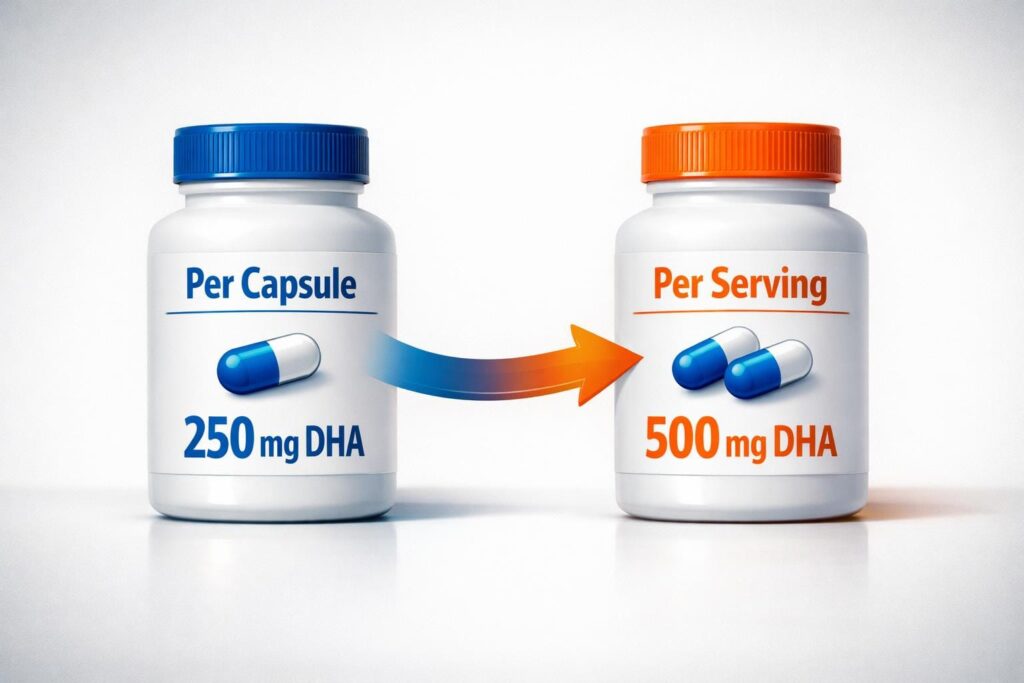
The easiest way to think about it is this: the front of the bottle may show the headline number, but the back of the label shows the real dose.
If you understand this one thing, you will avoid most buying mistakes.
Sometimes one serving is one capsule. In that case, per capsule and per serving are the same.
But many times, one serving is two capsules or even more. Then the numbers are different.
Let us keep it very simple.
If a label says:
- 1 capsule = 200 mg DHA
- 2 capsules = 400 mg DHA
Then the product gives 200 mg per capsule and 400 mg per serving.
Now imagine another product says:
- Serving size: 2 capsules
- DHA per serving: 400 mg
At first glance, this looks like the same thing. But the real amount in one capsule is still only 200 mg.
So, when comparing products, do not stop at the serving number. Always check what that serving actually contains.
This is the main point:
- A large number on the label does not always mean strong value in one capsule.
- You need to know what one capsule gives you, not just what the whole serving gives you.
If you’re wondering whether plant sources like flaxseed are enough, read this guide on ALA vs DHA and what your body actually needs.
Why Brands Show “Per Serving”
It is not always a case of misleading intent. you know? Sometimes, that’s just how the words end up on the page.
Brands often show numbers per serving because that is the standard format used on supplement labels. It helps them present the full recommended daily amount in one place.
Nothing’s wrong with that. The problem starts when folks don’t check the serving size closely.
Also, a bigger number looks better on the front panel. That is normal marketing. A bottle that says “500 mg DHA” feels stronger than one that says “250 mg DHA,” even if both may be part of a two-capsule serving.
For a beginner, this can create confusion fast.
The product may not be lying. It may still be showing the correct number. But if the serving size is not noticed, the buyer can easily misunderstand the actual dose.
It’s not always about someone being shady. Sometimes, buyers just don’t read closely enough. And brands do a slick job presenting things.
That is exactly why label reading is a skill.
Once you learn it, you stop paying for confusion.
How This Mistake Can Waste Your Money
You’ll usually see this mistake crop up right when you start using the product.
At first, everything looks fine. The number on the label feels strong, and the price seems reasonable. But after a few days, you realize one capsule is not enough to meet your daily need.
So, you start taking two or three capsules instead.
Now the bottle finishes much faster than you expected.
This is where the real cost becomes clear.
Let’s take a simple example.
Product A shows 500 mg DHA, but that is for two capsules. So one capsule gives 250 mg.
Product B gives 300 mg in one capsule.
If your goal is around 600 mg per day, Product A will need three capsules. Product B will need only two.
Even if Product A looked cheaper at the start, you are using more capsules every day. You’ll just have to buy it again sooner.
Over time, you end up spending more without noticing it.
Here’s the easiest way to understand it.
This is why looking only at the front label can mislead you. The real value depends on how much you actually get per capsule and how long the bottle lasts.
Before buying, it helps to quickly check products that clearly mention DHA per capsule. You can explore a few options here on Amazon.
👉 “here on Amazon“.
How to Read a DHA Label Correctly
Reading a DHA label is not hard. You just need to check the right things in the right order.
Here is the simple method I recommend: read the label from the back, not the front.
That is where the actual serving size, DHA amount, and bottle value become clear.
- First, check the serving size. That’s the number of capsules for one full dose.
- Next, check the DHA amount per serving. This tells you the total DHA in that full serving.
- You can divide it by the number of capsules if you need to. That’ll give you the real DHA per capsule.
- Also check how many servings are in the bottle. This helps you know how long the product will last.
- Do not trust only the front label. The front often shows the big number, but the back shows the real details.
- If one product says 500 mg DHA per serving and the serving size is 2 capsules, then each capsule gives only 250 mg DHA.
The main idea is simple: read the label carefully before buying. That one habit can save money and avoid confusion.
Supplement labels follow a standard format, and understanding them properly is recommended by authorities like the U.S. Food and Drug Administration.
A Simple Example
Let’s keep this practical.
Say you are comparing two DHA products online.
Product A
- 500 mg DHA per serving
- Serving size: 2 capsules
Product B
- 300 mg DHA per capsule
- Serving size: 1 capsule
At first glance, Product A looks stronger because of the bigger number.
But when you break it down, one capsule of Product A gives only 250 mg DHA. Product B gives 300 mg in a single capsule.
So, per capsule, Product B is actually stronger.
Now think about your daily use.
If your goal is around 300 mg DHA per day, Product B gives that in one capsule. With Product A, you need two capsules to reach the same level.
That means more pills to take and the bottle runs out faster.
This is where many people go wrong. They compare the big number on the label instead of checking what one capsule actually provides.
Different brands present their numbers in different ways. Some show total omega-3, some highlight DHA, and some split the dose across multiple capsules.
If you don’t check properly, it’s easy to pick the wrong product.
A better approach is simple: ignore the big number for a moment and focus on how much DHA you get in one capsule.
If you want to see real examples, you can check some vegan DHA supplements with clearly mentioned per capsule dosing on Amazon.
👉 Is “vegan DHA supplements with clearly mentioned per capsule dosing”
Common Label Tricks to Watch
Some supplement labels are pretty clear. Others can trip you up if you’re not reading ’em right.
- Sometimes the label shows total oil, not actual DHA. The number may look high, but the DHA may be much lower.
- So many brands hide the real detail in a small font. The important part is often written in tiny text.
- A product may mix EPA and DHA together. That is fine, but it is not the same as pure DHA.
- The serving size may be unclear at first glance. Many buyers miss this and think one capsule gives more than it really does.
- A big number on the front can look impressive, but it may be for more than one capsule.
- Some labels are designed to look stronger than they are. That is why the back label matters most.
So before buying, always check the full details. Do not get distracted by a big number on the front. The real value is usually in the small print.
If the serving size is not clear at first glance, that is already a reason to slow down and double-check the label.
Who Should Focus on Per Capsule Value
Some people should pay special attention to per capsule strength.
If you have daily life is fast, you probably do not want to swallow many capsules every day. In that case, a stronger per capsule product is easier to use.
People who want exact dosage also need to look closely. If you are trying to match a specific intake, per capsule value matters more than the total serving number.
Anyone who wants fewer pills should also focus on this. A supplement that gives more DHA in one capsule is usually simpler to follow.
Parents, busy professionals, and older folks, they often just want things easy. So, a product with a clearer, stronger dose per capsule? That’s probably the way to go for them.
So, the right question is not only “How much DHA is on the label?”
The better question is “How much DHA do I get in one capsule?”
That question leads to better buying decisions.
Best Way to Compare Two DHA Products
When two products look similar, compare them in this order:
First, check the serving size.
Second, check the DHA amount per serving.
Third, calculate the DHA per capsule.
Fourth, compare the price per capsule, not just the bottle price.
This gives a much clearer picture.
For example, a bottle priced higher may still offer better value if it gives more DHA in one capsule and lasts longer with fewer daily capsules.
A cheaper bottle may turn out expensive if you need more capsules every day.
That is the real comparison.
Smart buyers do not buy the cheapest bottle. They buy the bottle that gives the best value for the dose they actually need.
After reviewing many supplement labels, one thing becomes clear: the people who read the serving size carefully make better decisions.
They do not just buy a bigger number – they buy the dose that actually fits their routine.
Final Verdict
The main lesson is simple.
Do not trust the front number alone.
Always check both DHA per capsule vs per serving. One shows the real strength in each capsule, while the other shows the total dose in the full serving.
Both matter, but they are not the same.
If you ignore serving size, you may buy a product that looks strong but gives less in one capsule than you expected. That can lead to wrong dosage, more capsules per day, and higher cost.
The safest habit is to read the full label before buying.
Do that every time, and you will make better choices.
It’s simple, really. Do not rely on the biggest number alone. Look for what’s actually valuable.
If you want a shortcut, check our curated list of trusted vegan DHA supplements with clear per capsule dosing.
Final CTA
Before you order any DHA supplement, pause for a moment and check the label properly. Look at the serving size, calculate the actual DHA per capsule, and compare the bottle with others in the same way.

A smart buyer does not fall for the biggest number on the front. A smart buyer looks for real strength, clear dosing, and honest value.
That one habit can save money, reduce confusion, and help you choose a DHA supplement with confidence.
Before you buy your next DHA supplement, take 30 seconds to check the serving size and calculate the DHA per capsule.
That small step can save money, reduce confusion, and help you choose a supplement that actually works for your routine.
For more in-depth information, explore our related guides below to better understand vegan DHA, algal oil, and choosing the right supplement. Blog
Disclaimer: This article is for educational purposes only. Always consult your paediatrician before starting new supplements.
Disclaimer: This post contains affiliate links. If you buy through these links, I may earn a small commission at no extra cost to you. It helps me keep sharing useful content with you.