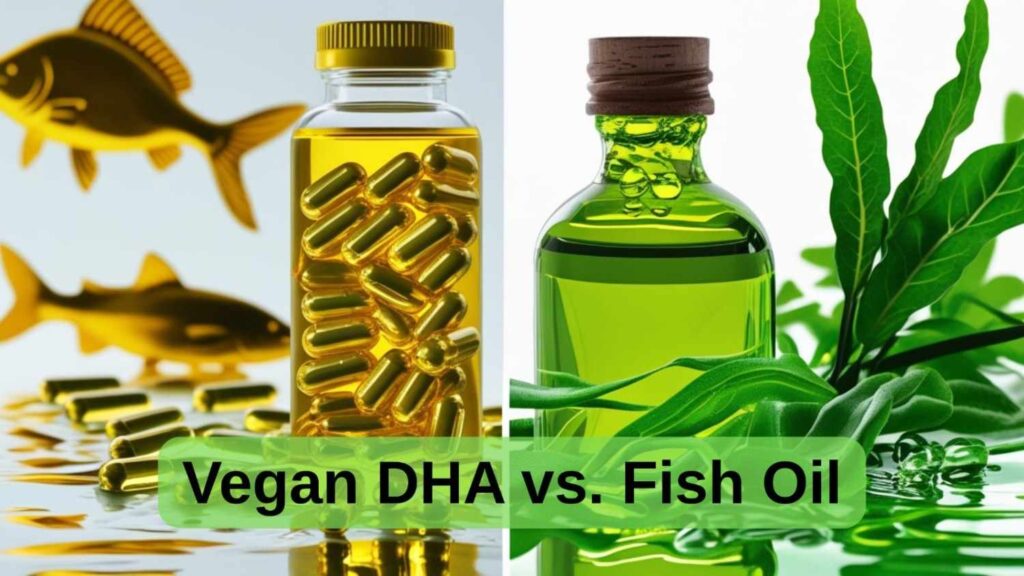
Your fish oil bottle is almost empty, and this time you’re not sure you want to buy another one.
Maybe the burps finally got to you. Maybe a relative pointed out that fish oil isn’t exactly vegetarian. Maybe you read that algae can do the same job and wondered if that’s really true.
So, you search the question that sounds simple: can vegan omega 3 replace fish oil in India?
Mostly yes. But there are three conditions, and they decide whether the switch actually works for you. The omega 3 itself is the same. The details around it are where people go wrong.
I’ve been vegetarian for more than fifteen years, so fish oil was never an option for me. For the first ten of those years, I assumed flaxseeds and walnuts were covering my omega 3. Then, about five years ago, a magazine article explained the difference between ALA and DHA, and that’s where my interest in this subject started. I now write about it at VeganVitaa, and I checked the products below against lab data instead of trusting their labels.
Each condition is explained below, followed by three vegan options to compare. If absorption is your bigger worry, that has its own guide: Vegan DHA Absorption in India.
Can Vegan Omega 3 Replace Fish Oil in India? The Short Answer
For EPA and DHA, yes. These are the two fatty acids people take fish oil for, and they are the same molecules whether they come from a fish or from algae. Fish mostly pick them up through the food chain, and that chain starts with algae. So algal oil goes to the original source instead of being a copy of fish oil.
The yes comes with three conditions:
- The label must show EPA and DHA in mg. “1000mg omega 3” often refers to the total oil, not the EPA and DHA inside it. That actual amount can be a fraction of the number on the front.
- Your dose has to match what you were taking. A fish oil capsule and an algal capsule rarely contain the same amounts, so swapping one capsule for one capsule can leave you with noticeably more or less than before.
- Some people shouldn’t switch on their own. Blood thinners, a prescribed omega 3, or a diagnosed heart, liver or triglyceride condition all need a doctor in the loop.
| Your situation | Can vegan omega 3 replace fish oil? | What to do |
| General wellness, no medical condition | Yes, in most cases | Pick a product that lists EPA and DHA in mg |
| Taking fish oil for triglycerides or cholesterol | Possibly, but dose matters | Compare EPA and DHA in mg, tell your doctor |
| On blood thinners or a prescription omega 3 | Don’t switch on your own | Ask your doctor first |
| Pregnant or breastfeeding | Algal DHA is commonly used, but dose matters | Confirm the amount with your doctor |
What Stays Exactly the Same
The fatty acid itself is the one thing that doesn’t change. Whether it came from a sardine or from microalgae grown in a tank, EPA is EPA and DHA is DHA.
Research supports this reasonably well. A 2025 trial of 74 adults compared microalgal oil with fish oil and found that the algal oil raised blood levels of both DHA and EPA about as well as fish oil did. The authors called it statistically non-inferior. One trial isn’t the final word. It covered adults taking supplements for a few months, and the algal oil used had both EPA and DHA, which isn’t true of every algal product. Read the study here.
The usual rules apply to both: read EPA and DHA in mg on the back of the bottle, and keep it out of the heat, because a kitchen cabinet in an Indian summer is hard on either one.
If fish oil was working for you, switching shouldn’t mean starting over, as long as the EPA and DHA numbers match what you were taking. The differences that do exist are practical ones, and they come next. For the full side by side, see Fish Oil vs Algal Oil.
What Actually Changes When You Switch
The big change is the EPA to DHA split.
Fish oil capsules lead with EPA. A typical salmon oil lists 180mg EPA and 120mg DHA per capsule, and a high strength fish oil lists 450mg EPA and 300mg DHA. Vegan capsules look different. The best numbers I could find come from Unbox Health, an Indian lab testing platform that buys products off the open market and has them tested at accredited labs.
Unived Ovegha claims 500mg DHA per capsule. The lab measured 436mg DHA and just 5mg EPA. Origins Nutra Algal Omega-3 claims 120mg EPA and 300mg DHA. The lab measured 138mg EPA and 319mg DHA.
So algal capsules come in two shapes. Many are DHA-led, with almost no EPA. A few carry both. If you took fish oil mainly for DHA, a DHA-led capsule covers it, and then some. If you took it for EPA, because of triglycerides or joints or your heart, the capsule you pick decides whether you keep getting it.
| Typical salmon oil (label claim) | Unived Ovegha (lab measured) | Origins Nutra Algal Omega-3 (lab measured) | |
| EPA per capsule | 180mg | 5mg | 138mg |
| DHA per capsule | 120mg | 436mg | 319mg |
| EPA + DHA | 300mg | about 441mg | about 457mg |
| Independent test | Fish oils with this claim are rated A+ to D | A+, rating has since expired | A+, active until July 2027 |
Price is the other change. Algal oil usually costs more per mg than fish oil, though budget options exist. I haven’t put rupee figures here because they shift every month. The switching section below shows how to work out cost per 100mg yourself.
Where Fish Oil Still Has the Edge
It would be easy to write this guide as a win for algae. It isn’t, quite.
- More research. Most big omega 3 trials, especially on triglycerides and heart outcomes, used fish oil. Algal oil has a smaller body of trials, and it’s growing.
- Easier EPA to trust. Fish oil is the simpler way to get EPA. Among the vegan products with EPA claims in the Unbox Health listings I looked at, two earned A+ (one of those ratings has since expired), one scored C and three scored D. So vegan EPA exists in India, but the label alone won’t tell you which kind you’re buying.
- Higher doses. Fish oil capsules can reach large EPA doses quickly. With vegan options you may need several capsules to get close.
Fish oil isn’t immune to label problems either. Among fish oils making that same 180mg EPA and 120mg DHA claim, Unbox Health’s ratings run from A+ to D. No category gets a free pass. What protects you is reading the numbers and looking for independent testing.
Where Algal Oil Makes More Sense for Indian Vegetarians
For many families, this part decides it.
- It fits how you eat. No fish at any stage, which matters for vegetarian, Jain and many religious households.
- No fishy aftertaste for many people. Burps are a common complaint with fish oil. Plenty of algal oil users say they don’t get them, though it isn’t guaranteed.
- A controlled source. Microalgae are grown in tanks, so ocean contamination isn’t part of the picture. That doesn’t make every product clean. Origins Nutra’s lab report showed zero lead, arsenic, cadmium and mercury. Unived’s showed lead barely detectable when it was tested. That’s the kind of result worth looking for.
Neither list makes the choice for you. Your reason for taking omega 3 does.
Talk to Your Doctor First If…
Switching is easy. Switching without telling anyone who manages your health is where problems start. Check with your doctor if:
- you take blood thinners or have a bleeding disorder
- you have surgery coming up
- your doctor prescribed an omega 3 medicine or gave you a specific EPA dose
- you have a diagnosed heart, liver or triglyceride condition
- you’re pregnant or breastfeeding
The NIH fact sheet on omega 3 covers safety and drug interactions in detail. If triglycerides are the reason you take omega 3, this guide goes deeper: Vegan Omega 3 for High Triglycerides in India.
None of this means you can’t switch. It means the dose should be a decision you and your doctor make with the numbers in front of you.
How to Switch Without Losing Your Dose
Do these four things before you order anything.
- Find what you take now. Flip the fish oil bottle. Add EPA and DHA for one capsule, then multiply by how many you take a day. Ignore the oil weight.
- Do the same for the vegan product. Check the serving size too. Some labels list numbers per two capsules, which makes them look stronger than they are. DHA Per Capsule vs Per Serving explains this trap.
- Decide what you’re keeping. If EPA was the point, look for a product that states EPA in mg and has an independent test. If DHA was the point, a DHA-led capsule covers it.
- Give it time. Don’t judge it in two weeks. Look at it after a couple of months, and keep taking it with a meal.
Here’s a worked example. Say you take two salmon oil capsules a day, each with 180mg EPA and 120mg DHA. That’s 360mg EPA and 240mg DHA, so 600mg combined. One Unived capsule gives about 436mg DHA but almost no EPA, so you’d be ahead on DHA and far behind on EPA. Two Origins Nutra capsules would give about 276mg EPA and 638mg DHA, going by the lab numbers. That’s closer on EPA and well over on DHA. No vegan capsule copies a fish oil’s EPA to DHA ratio. You trade one for the other, and that’s fine as long as you know it.
To compare prices fairly, use this: price per day, divided by EPA and DHA in mg per day, times 100. If a product costs ₹20 a day and gives 500mg, that’s ₹4 per 100mg. Do the same sum for each option and the better value shows up fast.
Best Vegan Options to Replace Fish Oil in India
I kept the list to three, and I’ve marked what is measured and what is only a label claim. Where independent lab data exists, I used it, along with the date of the rating. Where it doesn’t, I say so. I’d rather tell you a number is unverified than hide it. Products whose numbers I couldn’t pin down, or whose independent results looked worrying, are left out.
| Product | EPA | DHA | Evidence | Check before buying |
| Origins Nutra Algal Omega-3 | 138mg (lab) | 319mg (lab) | Unbox Health A+, active until July 2027 | Serving size, sold on the brand site |
| Unived Ovegha | 5mg (lab) | 436mg (lab) | Unbox Health A+, since expired | Serving size, current price |
| Naturaltein Ultimate Vegan Omega 3 | Not listed | 500mg per serving (label) | Reports shared by the brand | Softgels per serving |
1. Origins Nutra Algal Omega-3: both EPA and DHA, with a current A+
Lab measured per capsule: EPA 138mg | DHA 319mg | ALA 39mg (label claims 120mg EPA and 300mg DHA)
This is the only vegan capsule in this guide with a current independent A+ and a meaningful amount of both EPA and DHA. The lab numbers came in at or above the label, and lead, arsenic, cadmium and mercury were all zero. Two things to know. The brand asked for the rating, though Unbox Health says it bought the batch itself and the brand had no influence. And the tested batch came from the brand’s own website, which is also where it’s sold. I couldn’t confirm a listing on Amazon India, so the link below goes to the brand.
Best for: people who took fish oil for both EPA and DHA.
- Pros: lab numbers at or above the label, both fatty acids present, clean heavy metal results
- Cons: EPA is still well below a high strength fish oil, comes in a 28 count pack on the brand site, and I couldn’t confirm it on Amazon India
Check Origins Nutra Algal Omega-3
2. Unived Ovegha: DHA-led, with independent test data
Label claim per capsule: DHA 500mg | Lab measured: DHA 436mg, EPA 5mg
Unbox Health bought this off the open market and tested it. DHA came in about 13% under the label claim, heavy metals were barely there, and EPA is close to zero. The A+ rating has since expired, so a newer batch hasn’t been tested.
Best for: replacing the DHA part of fish oil, and anyone who wants an independent test behind it.
- Pros: independent lab test, low contaminants, high DHA per capsule
- Cons: doesn’t replace the EPA in fish oil, the rating has expired, and you should check the serving size and current price on the listing
3. Naturaltein Ultimate Vegan Omega 3: high DHA, brand shared reports
Label: 500mg DHA per serving | EPA not listed | algae source
The listing says 1000mg algae oil and 500mg DHA per serving, which is exactly the oil versus DHA split this guide keeps pointing at. Test reports from a testing service say the label matches and heavy metals pass. Those reports come from the brand’s side and appear to be about two years old, so they’re useful, not final.
Best for: people who want a high DHA softgel and like seeing test reports.
- Pros: high DHA, test reports available, softgel form
- Cons: no EPA listed, and the packs come in 30 and 60 softgels, so check how many make one serving
Disclaimer: This post contains affiliate links. If you buy through these links, I may earn a small commission at no extra cost to you. It helps me keep sharing useful content with you.
FAQs
Q. Can I stop fish oil suddenly and start vegan omega 3?
For most healthy people, yes. There’s nothing like withdrawal. If your doctor prescribed the fish oil, or you take it for a diagnosed condition, ask before changing anything.
Q. Is vegan EPA as good as fish oil EPA?
It’s the same molecule, and the 2025 trial above found algal oil raised blood EPA about as well as fish oil. The practical catch is in India. Few products list meaningful EPA, and among the vegan ones Unbox Health has rated, scores ran from A+ to D. Check for an independent test before trusting the label.
Q. Why does algal oil cost more?
It’s grown in controlled tanks and processed carefully, which usually costs more than fish oil. Cost per 100mg of EPA and DHA tells you more than the price on the bottle.
Q. Do I need more capsules after switching?
Possibly. It depends on the mg. Work out your current daily EPA and DHA, then see how many capsules of the new product it takes to get there. Check serving size first.
Q. Is 1000mg vegan omega 3 the same as 1000mg fish oil?
No. Both numbers often mean total oil weight, and the EPA and DHA inside can be very different. Compare EPA and DHA in mg, not the headline. How to Read Omega 3 Label shows how.
Conclusion
So, can vegan omega 3 replace fish oil in India? For DHA, yes, and the research backs it. For EPA, it depends on the product. Pick one that states EPA in mg and has an independent test behind it, because vegan products claiming EPA have scored anywhere from A+ to D.
The switch works when three things line up: the label shows EPA and DHA in mg, the dose matches what you were taking, and your doctor knows if you have a condition or take medication. Get those right and you aren’t giving anything up. Get them wrong and you can end up taking less than before without realising.
Start with one sum. Flip your fish oil bottle, work out your daily EPA and DHA, then pick the vegan product that comes closest. That’s the whole decision, and it takes about five minutes.
If you want a wider look at reading labels before you buy, start with How to Read Omega 3 Label.
About the Author
Kamal Mishra is a health & nutrition writer and vegan wellness advocate. He is the founder of VeganVitaa – India’s trusted vegan DHA resource for plant-based families.
For more in-depth information, explore our related guides below to better understand vegan DHA, algal oil, and choosing the right supplement. Blog
Disclaimer: This article is for educational purposes only and is not medical advice. Please consult your doctor or a registered dietitian before starting any supplement, especially if you are pregnant, have a health condition, or are giving it to a child.