
This blog was updated in 30th October 2026 to provide the latest information on DHA for teenagers in India.
“He sits with his books for three hours and still can’t tell me what he read.”
I hear some version of this from parents almost every week. The usual guess is phones, and honestly, phones do play a part. But in vegetarian homes there is another question that rarely comes up: is my child getting any DHA at all?
I have been vegetarian for 15 years, and when I first looked into DHA for teenagers, one thing surprised me. DHA is found in fish and algae, and almost nowhere in a normal vegetarian thali. So a teenager who eats no fish can go years with very little of it, and nobody notices, because there is no clear sign and no test most families ever think of.
I will say this upfront so you do not get your hopes up. DHA will not fix marks by itself, and the studies on teens are mixed. Sleep, stress, iron and B12 matter just as much. But it is a real gap in many vegetarian diets, and it is worth understanding.
Below I explain what DHA does in a growing brain, where vegetarian teens can get it, and how to choose a supplement if your doctor agrees. I have also listed three algal oil options sold in India, each with the DHA amount from its label.
What Exactly Is DHA?
DHA stands for docosahexaenoic acid. It is an omega-3 fat, and it is the main omega-3 your brain uses. Around 40% of the polyunsaturated fats in the brain are DHA. It sits in the membranes of nerve cells, the thin outer layer that lets one cell pass a signal to the next.
The body makes very little DHA on its own. So whatever reaches a teenager’s brain depends mostly on what they eat or take as a supplement.
Here is where Indian families often get caught. DHA is found directly in fatty fish and in algal oil. A vegetarian diet has almost none. If your teenager does not eat fish regularly, the intake can be close to zero without anyone noticing, because there is no obvious symptom and no simple test you can do at home. You can read more about this gap in our guide on DHA deficiency in India.
One honest point before we go further. DHA is not a cure for poor focus. Sleep, screen time, iron levels and exam stress matter just as much. DHA is one piece of the puzzle, and for vegetarian teens it is a piece that is often missing.
Where Can a Teenager Get DHA?
Direct sources (these contain actual DHA)
- Algal oil: Microalgae are where DHA starts. Fish have DHA only because they eat these algae. For a vegetarian or vegan teen, algal oil is the one direct source.
- Fatty fish: Salmon, sardines and mackerel, if your family eats fish.
- DHA-enriched eggs: These have a small amount, not enough to rely on.
Foods that give ALA, not DHA
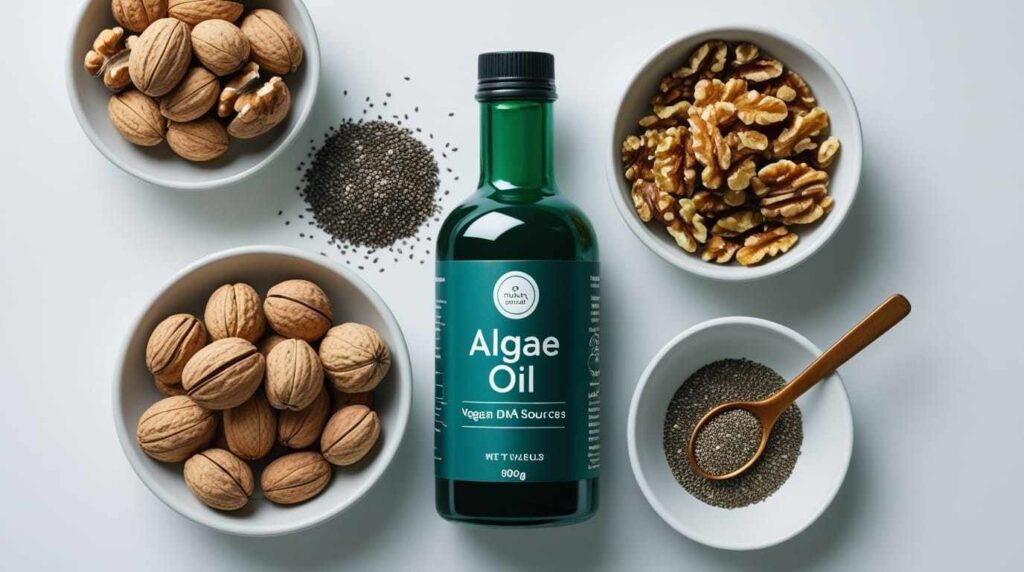
Walnuts, flaxseeds and chia seeds are good foods and I would keep them in your teen’s diet. But they contain ALA, a different omega-3. The body converts only a small fraction of ALA into DHA, so please do not count them as a DHA source.
A note on seaweed
Common seaweeds like nori, wakame and kombu give very little DHA. Only certain microalgae are rich in it, and that is what algal oil supplements are made from.
For a vegetarian teenager, food alone rarely closes the gap. That is why algal oil is the practical option. The right daily amount depends on your child’s age and health, so please check with your paediatrician before starting.
For a complete understanding of plant-based omega-3, you can read our detailed Vegan Omega-3 Guide.
How DHA Helps Teenage Brain Development
The teenage brain is not fully developed – it won’t be until the mid-20s. During the teenage years, it is actively rewiring itself, building new connections, pruning old ones, and laying the foundation for how that person will think and learn for the rest of their life.
DHA is one of the primary fats that makes this process work properly.
At the most basic level, DHA builds and maintains the membranes around brain cells. Healthier membranes mean faster, cleaner communication between neurons. This directly affects how quickly a teenager can understand new concepts, how well they retain what they study, and how clearly they can think under pressure.
Beyond structure, DHA supports neuroplasticity – the brain’s ability to learn and adapt. A teenager with good DHA levels can pick up new skills faster, make connections between ideas more easily, and hold onto information longer after studying.
Decision-making and emotional stability are also connected to DHA. The prefrontal cortex – the part of the brain responsible for judgment, impulse control, and managing emotions is especially DHA-dependent during teenage years. This is why teenagers with low DHA often seem more impulsive, irritable, or emotionally overwhelmed than expected.
And during hormonal changes which every teenager goes through – a well-nourished brain handles the stress better. Not perfectly. But noticeably better.

DHA for Memory Power (Real, Noticeable Improvements)
I’ve personally seen teenagers who study for hours but remember nothing.
That doesn’t mean they’re weak.
It means their brain cells are tired.
Here’s how DHA for Teenagers helps:
Better short-term memory
- Perfect for studying chapters, formulas, diagrams.
Faster recall
- During exams, they can remember answers quickly.
Less forgetting
- Their brain holds information more efficiently.
Stronger long-term memory
- Important lessons stay stored longer.
One parent told me: “My daughter remembers entire biology diagrams now without struggling.”
That’s DHA working quietly in the background.
DHA for Study Focus & Attention in the Digital Age
Let’s be honest about what Indian teenagers are dealing with today.
Instagram, YouTube Shorts, gaming, reels – the competition for a teenager’s attention has never been more intense. And their brains, still developing, are genuinely vulnerable to this kind of constant stimulation.
The result is predictable. Sitting down to study feels harder than it used to. Reading a full chapter without drifting feels impossible. Even when the phone is away, the mind keeps jumping.
This is not entirely about willpower or discipline. It is also about brain chemistry.
DHA directly supports the prefrontal cortex – the part of the brain responsible for sustained attention, filtering distractions, and staying on task. When DHA levels are adequate, study sessions last longer, reading feels less effortful, and the mind can hold focus through difficult material.
I have spoken to parents in Surat who noticed this shift in their teenagers within 6-8 weeks of consistent DHA supplementation. Not a dramatic transformation just a quieter, more focused version of the same teenager. Less irritability. Longer sitting time. Better mood after studying.
That is what adequate DHA does. It does not eliminate distractions. It gives the brain the foundation to manage them better.

Best Natural Sources of DHA for Teenagers
If you want to increase DHA naturally, here are the best options:
1. Algae-based DHA (vegan + pure)
This is the same DHA fish get by eating algae so why not take it directly?
2. Walnuts
Brain-shaped nuts that actually support the brain!
3. Chia seeds & flax seeds
Great for everyday smoothies.
4. Seaweed
A powerful plant source.
But here’s the truth:
Today’s teens don’t get enough DHA from food alone. For this reason, supplements are growing in popularity all over the world, particularly vegan algae DHA.
Using DHA supplement in teenage years (vegan) is the cleanest, safest, and fastest method.
Vegan DHA vs Fish Oil for Teenagers
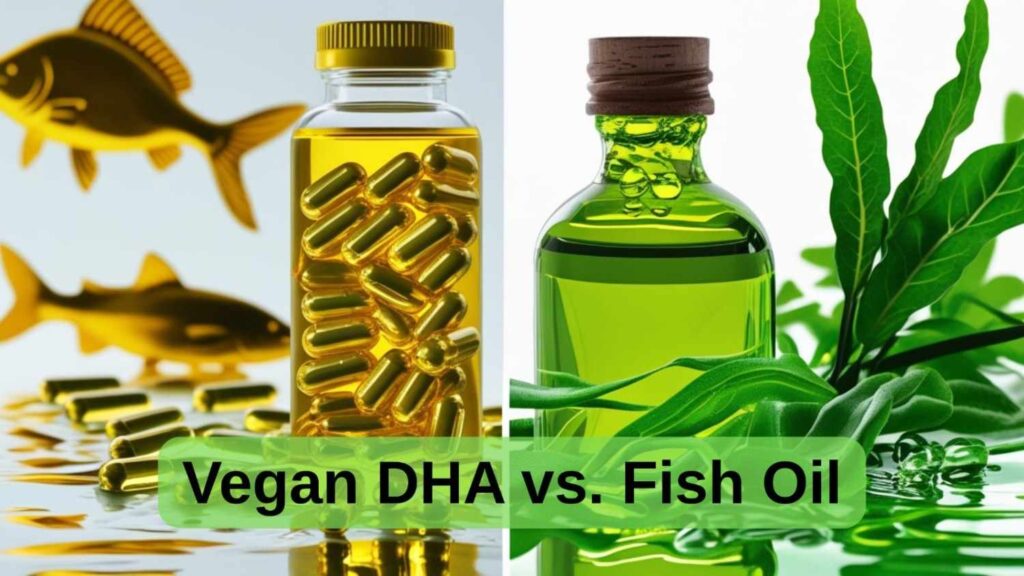
Most parents assume fish oil is the default way to get DHA. It is the older and more researched option, so that is fair. But for a lot of Indian families it simply does not fit. Some do not eat fish at all, some will not give their child anything animal-based, and some teenagers refuse the capsule after the second burp.
Here is how the two actually compare.
What they have in common
Both give your teen DHA, the same molecule. Fish get their DHA from eating algae, so algal oil is the original source. There is no solid evidence that one works better than the other for memory or focus in teenagers. Do not let any brand tell you otherwise.
Where they differ
- Diet fit: Algal oil is vegan and vegetarian. Fish oil is not. For many families, this decides the matter.
- Taste and burps: Fish oil capsules often leave a fishy aftertaste. Algal oil is usually milder, though it is not completely neutral for everyone.
- Contaminants: Algae are grown in controlled tanks, so ocean pollutants are not a concern. Good quality fish oil is also purified and tested, and its mercury levels are usually very low. The risk is mostly with cheap, untested brands. So whichever you choose, look for a third-party test report.
- EPA: Fish oil normally has both EPA and DHA. Many algal oils are DHA-rich with less EPA, though some now include both. Check the label.
- Cost: Fish oil is usually cheaper. Good algal oil costs more.
So which one?
If your family eats fish and your teen takes fish oil without any trouble, there is no need to switch. If your family is vegetarian or vegan, or your teen has given up on fish oil, algal oil is the sensible choice.
Still undecided? Our guide on vegan omega-3 vs fish oil in India goes through it in more detail.
How to Choose a DHA Supplement for Your Teen
Walk into any pharmacy and you will see “Omega-3 1000 mg” printed in big letters on the front. Ignore that number. Turn the bottle around and find the line that says DHA. That is what your teen actually gets. Plenty of bottles with a big omega-3 number have very little DHA inside.
Here is what I check before recommending anything:
- Algal oil is written on the label, so you know it is vegan.
- DHA per serving is printed clearly, in mg.
- Capsule type is plant-based, not gelatin.
- Test reports: the brand can show you a lab report if you ask. Good brands share it without fuss.
- Serving size: check whether a serving is one capsule or two. Brands hide this in small print, and it changes how much you are really paying.
How much your teen should take depends on age, weight and health. Please ask your paediatrician for the amount before you begin.
Vegan DHA Supplements Available in India
A quick note first. The links below are affiliate links. If you buy through them I earn a small commission, and you pay nothing extra. I only listed products that print the DHA amount on the label.
1. Inlife Vegetarian DHA (Algal Oil)
One serving is two capsules and gives 400 mg of DHA, so each capsule is about 200 mg. That is useful for a teenager, because your paediatrician can tell you whether one capsule or two is right. The capsules are vegetarian and liquid-filled, and a bottle of 60 lasts a month at two a day.
DHA per serving: 400 mg (2 capsules)
2. GreenOpia Vegetarian DHA Omega-3
Same idea, with a label that is easy to read. Each capsule has 200 mg of DHA and a serving of two has 400 mg. It also spells out how much of the oil is actually DHA, so you do not have to guess. Sixty capsules make 30 servings.
DHA per serving: 400 mg (2 capsules)
3. Ovegha Vegan Algal Omega-3
This one is stronger. A serving of two capsules gives 500 mg of DHA, so one capsule is roughly 250 mg. It works out cheaper per serving than the other two. Because the dose is higher, I would start with one capsule and let your paediatrician decide if more is needed. It uses a plant-based capsule shell and is made in India.
DHA per serving: 500 mg (2 capsules)
Disclaimer: This post contains affiliate links. If you buy through these links, I may earn a small commission at no extra cost to you. It helps me keep sharing useful content with you.
Where These Recommendations Come From
The information in this guide is based on research from:
— Harvard School of Public Health on omega-3 and brain health
— National Institutes of Health (NIH) official guidelines on DHA for cognitive development
All dosage recommendations and brain benefits mentioned are backed by peer-reviewed research – not marketing claims.
FAQs
Q. Why is DHA important for teenagers?
DHA is a main building block of brain cell membranes, and the teenage brain is still being built. It is also found in the retina of the eye. Teens who eat little or no fish and no algal oil can end up with very low intake. That is why this topic matters most for vegetarian and vegan families.
Q. Can DHA really improve my teen’s memory and focus?
It might help, but I will not promise it. Studies in children and teenagers have given mixed results. Some found small gains in things like reading or attention, others found no change. DHA works best as one part of the picture. Sleep, screen time, iron, vitamin B12 and exam stress affect focus just as much, and vegetarian teens are worth getting checked for iron and B12 as well.
Q. How long before I notice a difference?
There is no fixed answer. Brain cells take weeks to build up DHA, so expect to wait at least 6 to 8 weeks of daily use before judging anything. Some parents notice better mood or less irritability. Many notice nothing visible. If you see no change after two to three months, do not keep increasing the dose. Talk to your paediatrician and look at the other causes above.
Q. Can my teen get enough DHA from food alone?
If your family eats fatty fish a couple of times a week, probably yes. If you are vegetarian, usually not. Walnuts, flaxseeds and chia seeds give ALA, and the body turns only a small part of it into DHA. These foods are still good, but they are not a DHA source. For vegetarian teens, algal oil is the only direct plant-based option.
Q. How much DHA should a teenager take?
This depends on your child’s age, weight and health, so your paediatrician should decide. Most algal oil capsules sold in India are made for adults and carry 200 mg or more per capsule. Starting with one capsule and not exceeding what your doctor says is the safer way to begin.
Q. Is vegan DHA safe for teenagers?
Algal DHA is generally well tolerated at normal doses. The common side effects are mild, such as an upset stomach or a mild aftertaste. Check with your doctor first if your teen takes any regular medicine, has an allergy, or has a health condition. Stop the supplement and call your doctor if anything feels wrong.
Q. Does it matter when my teen takes DHA?
Take it with a meal that has some fat. DHA is a fat, and it is absorbed better with food. Pick a time you can keep up daily, since regular use matters more than the exact hour.
A Note for Parents
Before you buy anything, a few things worth doing first:
- Look at sleep. Most teenagers sleep far less than they need, and nothing makes focus worse faster.
- Ask about iron and B12. Vegetarian teens can run low on both, and low levels cause tiredness and poor concentration. A simple blood test from your doctor tells you where things stand.
- Talk to your paediatrician about DHA. Tell them your teen is vegetarian and ask whether a supplement makes sense and how much.
- Do not expect quick results. Give it at least 6 to 8 weeks of daily use before you judge.
- Do not turn it into pressure. A teen who is told “this will fix your marks” is being handed one more thing to fail at. Just make it part of the morning routine and leave it there.
You know your child better than any article does. Use this guide to ask better questions, not to replace your doctor.
Conclusion
People ask me, “Is DHA for teenagers actually worth it?”
It depends on what your child eats. If fish is on the plate a couple of times a week, they are likely fine. If your home is vegetarian or vegan, the chances are they get very little, and algal oil is the one plant-based way to fix that.
What I cannot tell you is that it will lift their marks. Nobody honestly can. Some parents see a calmer mood or steadier focus after a couple of months, and some see nothing at all. Both happen.
So here is what I would do in your place. Talk to your paediatrician first. Check your teen’s sleep, and ask about iron and B12 while you are there. If a DHA supplement makes sense, start with a small dose, give it every day, and look at how things are after two or three months.
And if you have already tried it with your own child, I would really like to hear what happened. Write it in the comments. Other parents reading this will find it more useful than anything I can say.
About the Author
Kamal Mishra is a health & nutrition writer and vegan wellness advocate. He is the founder of VeganVitaa – India’s trusted vegan DHA resource for plant-based families.
Further Reading on VeganVitaa
For more in-depth information, explore our related guides below to better understand vegan DHA, algal oil, and choosing the right supplement. Blog
- Best Vegan DHA Supplements in India — Top 3 Picks
- Best Vegan Omega 3 Capsules in India 2026
- How Much Omega 3 Do You Really Need Daily?
- Best Vegan DHA for Students in India
Disclaimer: This article is for educational purposes only and is not medical advice. Please consult your doctor or a registered dietitian before starting any supplement, especially if you are pregnant, have a health condition, or are giving it to a child.

Pingback: DHA for Muscle Recovery: The Nutrient Athletes Are Missing
Pingback: Best Vegan DHA for Students in India — Top 5 Picks