
One in ten Indian women has a thyroid disorder and most of them find out years after it started.
The tiredness they blamed on a busy schedule. The weight that would not shift no matter what they ate. The hair falling more than it should. The cold hands in summer. All of it quietly adding up until a routine blood test finally says what the body had been signalling for months.
India has one of the highest rates of thyroid dysfunction in the world. And the majority of those affected are vegetarian women the very group that has almost no direct EPA and DHA in their daily diet.
Omega 3 for thyroid health in India is a conversation that almost never happens. Not in clinics, not in family discussions, not even in most nutrition content. Thyroid medication gets discussed. Diet gets discussed. Omega 3 almost never.
At VeganVitaa, I started paying attention to this pattern after multiple readers wrote in about thyroid issues alongside their omega 3 questions.
That overlap made me want to understand the connection properly and share what the research actually says. This guide is the result of that research.
What VeganVitaa Readers Are Telling Me
Over the past year, a pattern kept showing up in VeganVitaa messages.
Women in their thirties and forties writing about omega 3 but mentioning thyroid issues in the same message. Hashimoto’s. Hypothyroidism. Fatigue that medication helped but never fully resolved.
Almost none of them had ever been asked about omega 3 by their doctor.
That pattern is what made me research this properly. I am not claiming omega 3 fixes thyroid problems the research does not support that. But for vegetarian Indian women dealing with a chronic inflammatory condition, understanding this nutritional gap seemed important enough to write about honestly.
Why Thyroid Problems Are Quietly Epidemic in India
Thyroid disorders in India are not rare anymore. They just rarely get diagnosed on time.
Estimates suggest that over 42 million Indians are living with some form of thyroid disease. The most common hypothyroidism and Hashimoto’s thyroiditis affect women far more than men. And within that group, vegetarian women in their thirties and forties are disproportionately represented.
Hashimoto’s thyroiditis is an autoimmune condition. The immune system mistakenly attacks the thyroid gland, causing inflammation that gradually reduces its ability to produce hormones. Over time, this leads to hypothyroidism low thyroid hormone levels that affect metabolism, energy, mood, hair, skin, and almost every system in the body.
The root driver of all of this is chronic inflammation.
And diet plays a direct role in how much inflammation the body is carrying not as a cure for thyroid disease, but as something that either adds to the burden or helps reduce it.
For most Indian vegetarian women, the diet is genuinely nutritious in many ways. But it is almost completely lacking in one specific anti-inflammatory nutrient direct EPA and DHA from omega 3.
High omega 6 cooking oils. Low omega 3 intake. No fish. No algal oil. The inflammatory environment builds slowly, and the thyroid already under autoimmune attack in many cases has one less nutritional defence working for it.
Diet did not cause the thyroid problem. But nutrition is part of the conversation that most Indian women with thyroid issues are simply never having.

For more on how DHA deficiency affects Indian vegetarians broadly –DHA Deficiency in Indian Vegetarians and Vegans
How Omega 3 Actually Supports Thyroid Function Simply Explained
This is where I want to be careful because the research is genuinely interesting but not yet conclusive enough to make strong claims.
Here is what the science currently suggests.
T4 to T3 conversion gets support.
Your thyroid produces T4 – the inactive form of thyroid hormone. Your body has to convert T4 into T3 the active form before it can actually use it. This conversion happens mostly in the liver and other tissues, and chronic inflammation directly interferes with it.
EPA and DHA reduce that inflammatory burden. When inflammation is lower, the enzymes responsible for T4 to T3 conversion work more efficiently. This does not mean omega 3 fixes thyroid hormone levels it means it removes one obstacle that was slowing the process down.
Cell membrane sensitivity improves.
Every cell in your body has receptors for thyroid hormone. For those receptors to work properly, the cell membrane needs to be fluid and flexible. DHA is directly incorporated into cell membranes – improving their flexibility and potentially improving how well cells respond to the thyroid hormone that is already available.
Autoimmune inflammation may reduce.
For people with Hashimoto’s – where the immune system is attacking the thyroid – omega 3 has shown some ability to reduce the inflammatory compounds that drive this immune response. The effect is modest, not dramatic. But for a condition where every reduction in autoimmune activity matters, modest is still meaningful.
One honest note, omega 3 does not produce thyroid hormones. It does not replace medication. What it may do is support the conditions under which thyroid function works better.
Research published in Frontiers in Endocrinology found that omega 3 supplementation showed potential benefits in reducing autoimmune thyroid markers particularly TPO antibodies in Hashimoto’s patients. The evidence is promising but still emerging. Read the full review here.
Omega 3 for Thyroid Health in India – What the Research Actually Shows
I want to be straightforward here because the research on omega 3 and thyroid health is encouraging but not yet the kind of settled science that exists for heart disease or triglycerides.
What studies consistently show is this omega 3 supplementation appears to reduce markers of thyroid autoimmunity, particularly TPO antibodies, in people with Hashimoto’s thyroiditis. TPO antibodies are what the immune system produces when it is attacking the thyroid. Lower antibody levels generally mean less immune attack on the gland.
A review in Frontiers in Endocrinology noted that omega 3 fatty acids have enough scientific rationale for use in thyroid autoimmune conditions including Hashimoto’s and subclinical hypothyroidism. Not as a replacement for medication, but as a nutritional support that addresses the inflammatory and immune environment around the thyroid.
For Indian vegetarian women specifically, this matters for one simple reason they are among the most omega 3 deficient populations in the world, and they also have some of the highest rates of Hashimoto’s and hypothyroidism. Whether that connection is direct or coincidental nobody can say for certain yet. But filling a clear nutritional gap in people already dealing with an autoimmune condition seems like a reasonable place to start.
The honest caveat omega 3 is not a thyroid treatment. TSH levels, T3, T4 these are not going to normalize from algal oil alone. If you are on thyroid medication, it stays. What omega 3 may do is give your thyroid and immune system a slightly better nutritional environment to work in. That is not nothing.
For official omega 3 intake guidance – NIH Omega 3 Overview.
For how this connects to broader DHA deficiency in Indian vegetarians – Omega 3 for Heart Health in India
Why Vegetarian Indian Women Are Most at Risk
Of all the people who write to VeganVitaa about omega 3 vegetarian women dealing with thyroid issues come up more than almost anyone else.
And yet they are almost never told about omega 3.
Here is why the gap is so much deeper for them specifically.
The average Indian vegetarian diet provides almost zero direct EPA and DHA. Flaxseeds and walnuts contain ALA a plant-based omega 3 that the body has to convert into EPA and DHA. That conversion rate is poor typically less than 5% for EPA and even lower for DHA.
For women, estrogen slightly improves that conversion rate compared to men. But even with that advantage, food-based ALA alone cannot provide therapeutic amounts of EPA and DHA especially for someone whose immune system is already inflamed and whose thyroid is under attack.
Fish oil was never an option for vegetarian Indian women. And until algal oil became more accessible in India, most of them simply had no direct DHA source at all.
Years of near-zero EPA and DHA quietly adds to an inflammatory load that the thyroid is already struggling under. It is not the cause but it is one more thing working against recovery.
Algal oil changes this. Direct EPA and DHA from microalgae the original source, before fish are even involved. No mercury. No animal products. Available in India now at practical prices.
For vegetarian Indian women with thyroid issues, this is not a luxury addition. It is one of the most straightforward nutritional gaps they can actually close.
For understanding why vegan omega 3 often does not work the way Indian women expect – Vegan Omega 3 Not Working in India
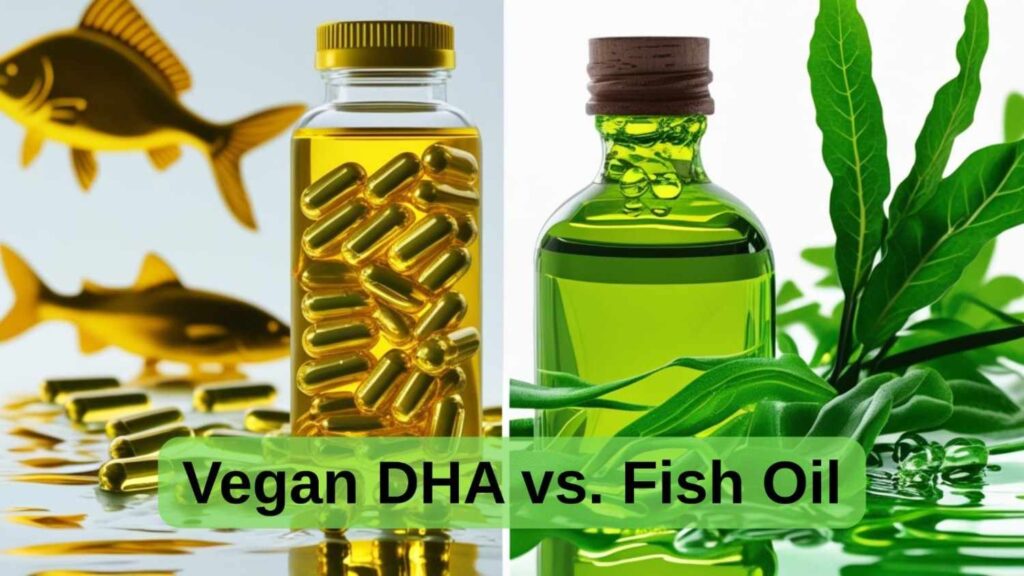
Vegan DHA vs Fish Oil – Which Is Better for Thyroid Support?
For most vegetarian Indian women with thyroid issues, this question has always felt irrelevant. Fish oil was never on the table.
But there is one specific reason algal oil is not just a substitute for fish oil it is actually the cleaner choice for someone dealing with an autoimmune thyroid condition.
Both fish oil and algal oil deliver direct EPA and DHA. The thyroid and immune benefits come from these two forms. On that level, they are equal.
Where they differ is everything else:
| Factor | Fish Oil | Algal Oil |
| Source | Ocean fish | Microalgae |
| EPA + DHA | Yes | Yes |
| Mercury risk | Possible | Zero |
| Microplastics | Possible | Zero |
| Vegetarian | No | Yes |
| Fishy smell/burps | Common | None |
| Autoimmune safe | Concerns with contaminants | Cleaner option |
For someone with Hashimoto’s an autoimmune condition the mercury and contaminant angle matters more than it does for a healthy person. Mercury has been shown to act as an autoimmunity trigger in some research. Algal oil removes that risk entirely.
Fish get their EPA and DHA from algae anyway. Algal oil simply removes the fish and everything that comes with them from the equation.
For vegetarian Indian women, that table ends the debate. Same EPA and DHA. No fish. No mercury. No autoimmune trigger risk.
For a detailed comparison – Fish Oil vs Vegan Omega 3
Best Vegan Omega 3 for Thyroid Health in India
For thyroid support specifically, you want a supplement that clearly shows both EPA and DHA on the label. EPA is the form most directly involved in reducing the inflammatory and autoimmune activity that affects the thyroid.
At VeganVitaa, these are the three I point toward when someone specifically mentions Hashimoto’s or hypothyroidism EPA and DHA content came first, brand name came last.
1. Wellbeing Nutrition Vegan Omega 3
One of the few Indian brands that clearly shows both EPA and DHA separately on the label. Clean algal oil source, vegetarian capsule, no contaminants. Strong choice for anyone serious about thyroid autoimmune support.
2. Deva Vegan Omega 3
Globally trusted, third-party tested, algal oil based. Transparent EPA and DHA numbers important when you are taking it for a specific health condition like Hashimoto’s. No guessing about what is inside.
3. Rasayanam Plant Based Omega 3
A newer Indian brand with algal oil base and clear DHA content. Good option for those who prefer a domestic brand with straightforward ingredients and FSSAI certification.
Before buying anything flip the bottle and find EPA on the label. Not just DHA. Not just total omega 3. EPA specifically. That is the number that matters most for thyroid and autoimmune support.
For a full comparison of top algal oil options in India – Best Vegan Omega 3 Capsules in India

How Much Omega 3 Do You Need for Thyroid Support?
This is where most people either take too little to notice any difference or take a random amount without understanding what the research actually used.
For thyroid support, here is a practical starting point:
For general anti-inflammatory support and hypothyroidism –
500 to 1000mg combined EPA and DHA daily. This covers the baseline anti-inflammatory benefit that supports T4 to T3 conversion and cell membrane health.
For Hashimoto’s thyroiditis autoimmune support –
1000 to 2000mg combined EPA and DHA daily. The studies that showed reduction in TPO antibodies used higher doses over longer periods typically 12 weeks minimum.
For beginners –
Start with one capsule daily with your main meal. Give your body 2 to 3 weeks to adjust before increasing.
One practical tip- take it with your heaviest meal of the day. Omega 3 is fat soluble and absorbs significantly better alongside food. Empty stomach means poor absorption and possible nausea.
Give it a minimum of 12 weeks before deciding whether it is helping. Autoimmune conditions respond slowly to nutritional changes 4 weeks is not enough time to judge.
Most important reminder – if you are on thyroid medication like levothyroxine, do not adjust your dose based on how you feel after starting omega 3. Keep your doctor in the loop. Omega 3 supports the nutritional environment your medication manages hormone levels. Both have their role.
For a detailed daily DHA and EPA dosage breakdown Vegan DHA Dosage Per Day
FAQs
Q. Can omega 3 cure thyroid disease?
No, and anyone saying otherwise is overpromising. It does not produce thyroid hormones or reverse Hashimoto’s. What it may do is reduce the inflammatory load that makes thyroid conditions harder to manage. Medication stays. This is nutritional support only.
Q. Is algal oil safe for Hashimoto’s?
Yes, and possibly better than fish oil for autoimmune conditions. Mercury has been linked to autoimmune triggers. Algal oil has zero mercury, same EPA and DHA, no animal products. For vegetarian Indian women straightforward choice.
Q. How long before I notice a difference?
Minimum 12 weeks possibly longer for TPO antibody changes. Most people quit at week 4 and miss the results entirely. Give it real time before deciding.
Q. Can I take omega 3 with levothyroxine?
Generally, yes. But tell your doctor everything you are taking, especially at higher doses. Do not adjust your medication based on how you feel after starting omega 3.
Q. Which matters more for thyroid – DHA or EPA?
EPA. It is the form most directly involved in reducing the inflammatory and autoimmune activity around the thyroid. Always check EPA is clearly mentioned on the label not just total omega 3.
Q. I eat flaxseeds daily. Do I still need a supplement?
Yes, flaxseeds give you ALA, not direct EPA or DHA. Your body converts less than 5% of ALA into usable EPA. For thyroid support where therapeutic amounts matter, food alone will not close this gap.
Conclusion
Thyroid disease in India is not going away it is getting more common, diagnosed later, and managed with less nutritional support than it deserves.
Omega 3 for thyroid health in India is not a cure. It is not a replacement for medication. And I will not pretend the research is more settled than it actually is.
What it is – is something most vegetarian Indian women with thyroid issues have simply never been told about. A nutritional gap that has been there for years, quietly making things harder.
Years of near-zero EPA and DHA – in a diet that is careful, considered, and doing almost everything right. That one gap does not announce itself. It just quietly adds to a load that is already heavy.
Medication helps. But it does not fix everything. And for most vegetarian Indian women with thyroid issues, nobody has ever asked about omega 3.
The research is not settled. I want to be clear about that. But it is pointing somewhere real and for someone already living with a chronic condition, one small nutritional addition that might help and cannot hurt is worth knowing about.
Start with one clean algal oil capsule daily. Take it with your main meal. Give it 12 weeks minimum. Keep your doctor informed.
At VeganVitaa, I have seen enough women ask about this connection to know it deserves an honest answer even if that answer is ‘we don’t fully know yet.’
That is all this is. One small, consistent addition to what you are already doing.
Where to Start, One Simple Step
Check your current supplement. Does it show EPA clearly on the label?
If not, that is your first fix.
Pick Wellbeing Nutrition, Deva, or Rasayanam from the options above. One capsule daily after lunch or dinner. Stay consistent for 12 weeks.
Then discuss your next thyroid blood test with your doctor. Let the numbers guide the conversation.
About the Author
Kamal Mishra is a health & nutrition writer and vegan wellness advocate. He is the founder of VeganVitaa – India’s trusted vegan DHA resource for plant-based families.
Further Reading on VeganVitaa:
For more in-depth information, explore our related guides below to better understand vegan DHA, algal oil, and choosing the right supplement. Blog
- Best Vegan Omega 3 for Women in India
- Omega 3 for PCOS in India
- Best Vegan Omega 3 for Hair Loss in India
Disclaimer: This post contains affiliate links. If you buy through these links, I may earn a small commission at no extra cost to you. It helps me keep sharing useful content with you.
Disclaimer: This article is for educational purposes only. Always consult your doctor before starting any supplement, especially if you are managing a thyroid condition or taking medication.

Pingback: Best Vegan Omega 3 for Women in India — Top 5 Picks